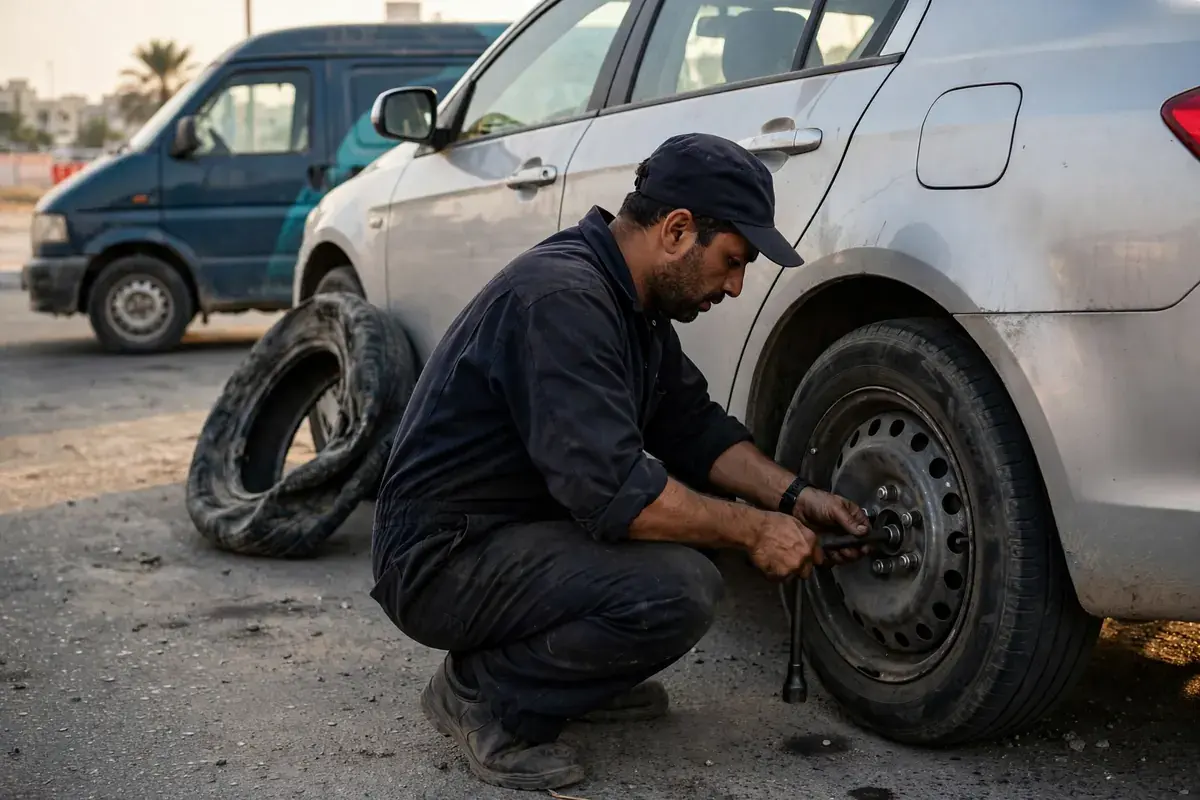
Mobile puncture repair

Flat Tyre Repair in Dubai for Nails, Screws and Slow Leaks

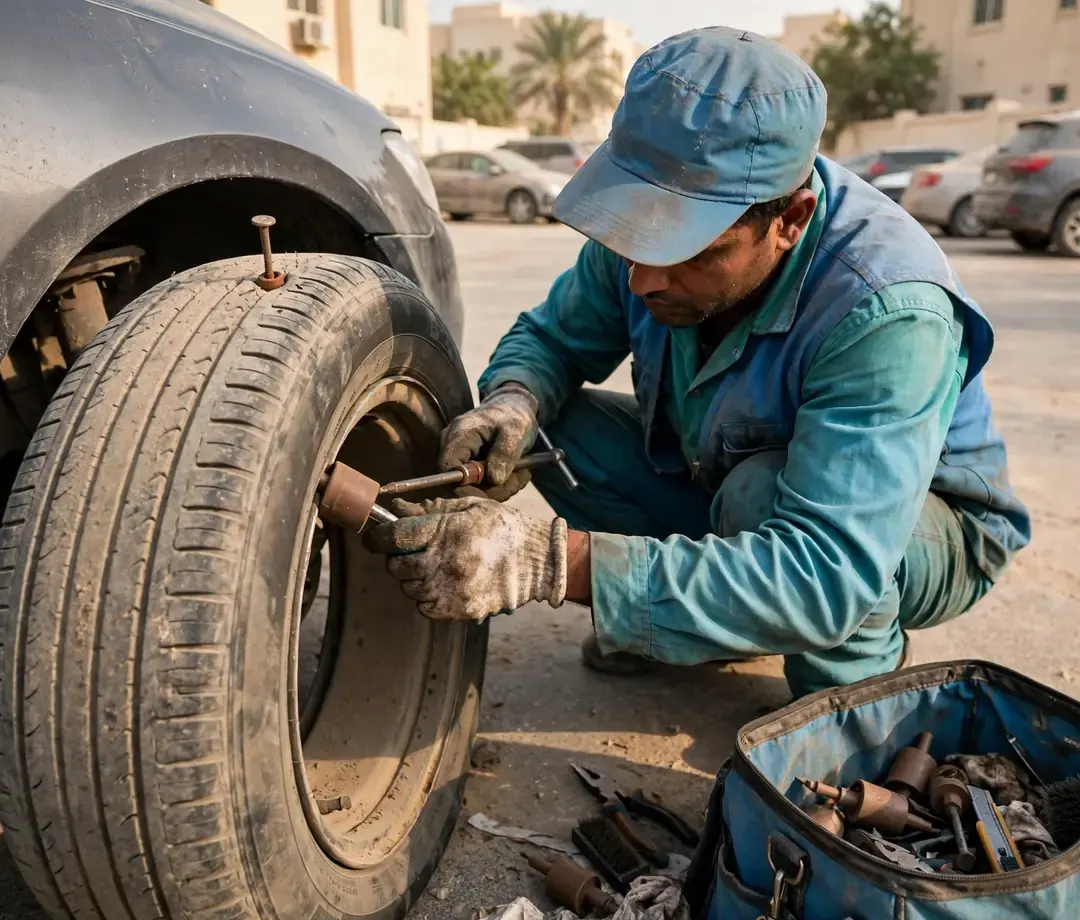
Technician inserting a repair plug into a punctured tyre tread at a Dubai roadside
Live call-outFlat Tyre Repair
1
Step 1 of 5Find the leak
Most repairs
Under 30 min
Available
24 hours
Warranty
Labour and parts
Fix or replace

Which Punctures Can Be Repaired?

Tyre makers and the British repair standard BS AU 159 broadly agree: where the hole sits matters as much as its size.

Usual verdict

Nail or screw in the central tread, 6 mm or less
Repairable
Hole wider than 6 mm
Replace
Damage in the shoulder
Replace
Cut, nail or bulge in the sidewall
Replace
Tyre driven while completely flat
Usually replace
Run-flat with a tread puncture
Depends on the maker

Reason

Nail or screw in the central tread, 6 mm or less
Inside the zone covered by the standard, if the inner liner is undamaged
Hole wider than 6 mm
Beyond the size Michelin and other makers accept for repair
Damage in the shoulder
Outside the central three quarters where repairs are allowed
Cut, nail or bulge in the sidewall
That part flexes constantly, so a repair cannot be trusted
Tyre driven while completely flat
Hidden casing damage is likely even after a short run
Run-flat with a tread puncture
Several bodies advise against it; check the brand's own policy

A permanent repair is only judged properly with the tyre removed from the wheel so the inside can be seen.

The no-go zone

Why Sidewall and Shoulder Damage Ends a Tyre

The tread is thick, braced by steel belts and fairly rigid. The sidewall is thin and bends with every rotation while carrying the car's weight, so any plug or patch there is flexed constantly and the bond can fail without warning. That is why Michelin and TyreSafe both rule out sidewall repairs entirely.

The shoulder, where tread curves into sidewall, has the same problem plus higher heat. BS AU 159 limits repairs to the central three quarters of the tread width for that reason. If a nail has gone in close to the edge, a new tyre is the honest answer even when the hole looks tiny.

Repair methods

Plug, Patch or Plug-Patch: How They Differ

How it works

String plug
A sticky cord pushed into the hole from outside, tyre still on the rim
Patch only
A rubber patch bonded to the inner liner after the tyre is removed
Plug-patch combination
A rubber stem fills the hole and a patch seals the liner in one piece
Sealant kit
Liquid pumped in through the valve, then the tyre is reinflated

Where it fits

String plug
Emergency use only; AAA and tyre makers treat it as temporary
Patch only
Seals the inside but leaves the hole through the tread open to moisture
Plug-patch combination
The method Michelin requires for its tyres and the usual permanent fix
Sealant kit
Gets you moving after a small tread puncture; not a lasting repair
What good practice looks like

Stages of a Proper Puncture Fix

  1. 01

    Find the leak

    The tyre is inflated and checked for escaping air, and any nail, screw or glass fragment is located before anything is pulled out.

  2. 02

    Inspect from the inside

    With the tyre off the rim, the liner is examined for scuffing or tearing that would mean the tyre was run too low.

  3. 03

    Prepare the hole

    The channel is cleaned out and the area around it buffed so the repair bonds to fresh rubber.

  4. 04

    Fit and cure the repair

    A plug-patch is drawn through from inside, pressed firmly into place and trimmed flush with the tread.

  5. 05

    Refit, inflate and test

    The tyre goes back on the wheel, is set to the pressure on your door placard and is checked again for leaks around the repair and the bead.

Used a sealant kit already? Tell the technician

Emergency sealant buys time, not a cure. Continental's kit, for example, handles tread holes up to 6 mm and then limits you to 80 km/h for a maximum of 200 km, and TyreSafe calls such kits temporary. Mention it when you book, keep speeds down and get the tyre properly assessed within that window.

After the repair

Pressure Checks That Catch a Problem Early

The sidewall figure is the most the tyre can safely hold, not what your car needs.

  • Use the figure on the driver's door jamb, fuel flap or handbook, not the number moulded on the sidewall
  • Check in the morning before driving, while the tyres are cold
  • Recheck the repaired tyre the next day and again after a week
  • Look at all four tyres, plus the spare, at least once a month
  • Watch for a pull to one side or a soft feel through the steering
Dubai conditions

Tyre Age, Summer Heat and When a Repair Is Not Worth It

There is little point patching a tyre that is already too old to use. Dubai's RTA counts a tyre's life from its manufacture date and says tyres beyond five years are not allowed on UAE roads. The four digit code at the end of the sidewall marking gives the week and then the year it was made.

Heat is the other factor. UAE police warn that tyres often fail in extreme summer temperatures, and worn or unfit tyres are punishable with AED 500, four black points and the car held for a week. Hot roads also push pressure up as you drive, so take readings in the cool of the morning.

FAQs

Flat Tyre Repair: Common Questions

  • Often, yes. If the nail is in the central tread, the hole is no wider than 6 mm and the inside of the tyre is undamaged, a plug-patch repair is normally acceptable. Leave the nail in place until the tyre is examined, as removing it usually makes the leak faster.

Losing air from a tyre right now?

Tell us where the car is and a technician will come to assess the puncture and repair it if the damage allows.